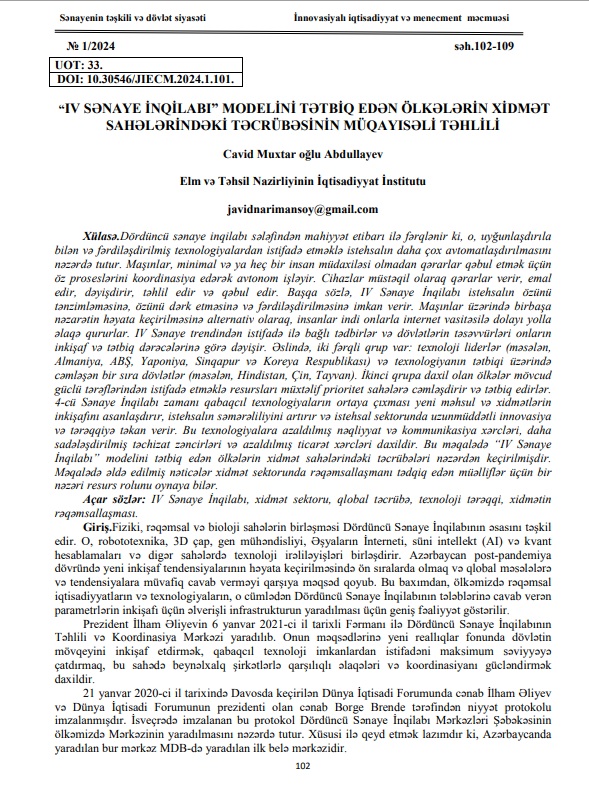
Comparative analysis of the experience of the countries applying the "IV Industrial Revolution" model in the service fields
Keywords:
IV Industrial Revolution, service sector, global experience, technological progress, digitization of serviceAbstract
In contrast to its antecedent, the fourth industrial revolution is predicated on increased production automation made possible by the application of adaptable and individualized technologies.
Autonomous machines function by coordinating their own processes in order to reach decisions with implemented. Indeed, there exist two discernible cohorts: technological frontrunners (e.g., Germany, the United States, Japan, Singapore, and the Republic of Korea), and several nations that prioritize technological implementation (e.g., China, Taiwan, and India). The nations comprising the second group allocate their resources and efforts towards distinct priority domains, capitalizing on their current
advantages. The advent of sophisticated technologies throughout the course of the Fourth Industrial Revolution stimulates enduring innovation and advancement in the manufacturing sector, facilitates the creation of novel products and services, and enhances production efficiency. The aforementioned technologies facilitate decreased trade costs, improved supply chain efficiency, and decreased transportation and communication expenses. This article provides a comprehensive analysis of the service sector experiences of nations that have implemented the "IV Industrial Revolution" framework. The article's findings have the potential to be utilized by scholars investigating digitization in the service industry as a theoretical resource.
References